If you run a metal shop, a CNC machining company or a laser cutting, welding or powder coating business, your website has one job: to bring you requests for quotation (RFQs) from purchasing managers and engineers who need parts made.
Keyword research decides whether that happens. Target the wrong keywords and you attract students, hobbyists and job seekers. Target the right ones and you show up at the exact moment a buyer at an OEM in Germany, Austria or the Netherlands is looking for a new supplier.
This guide walks through the seven-step keyword research process we use for manufacturing clients, from mapping how industrial buyers search to deciding which page each keyword deserves. All the examples come from metalworking: CNC machining, laser cutting, sheet metal, welding, steel structures and powder coating.
Let’s get started.
Table of Contents
What Is Keyword Research for Manufacturers?
Keyword research is the process of finding the words and phrases your target buyers type into Google (and, increasingly, into AI assistants) when they look for the processes, materials, certifications and capacities you offer.
For a manufacturer, that means much more than “CNC machining”. It includes the exact way a purchasing manager describes a requirement: “5-axis milling stainless steel small batch”, “EN 1090 EXC3 steel fabricator”, “powder coating large parts RAL 7016” or, in German, “Blechbearbeitung Lohnfertigung” (sheet metal contract manufacturing).
The keywords you shortlist at this stage become the backbone of your manufacturing SEO strategy. They decide which service pages you build, which articles you write and which terms you optimise them for.
Every keyword is evaluated against five criteria:
| Relevance | Does the keyword describe a process, material, certification or industry you actually serve? “Laser cutting acrylic” is irrelevant if you only cut steel. |
| Search intent | Is the searcher an engineer looking for a supplier, a student looking for a definition, or a hobbyist looking for a DIY tutorial? |
| Search volume | How many people search for it each month in each country you sell to, and in which language? |
| Search CTR | Do searchers click through to websites, or does Google answer the question directly in a featured snippet or AI overview? |
| Ranking difficulty | Who ranks today: marketplaces, directories, global platforms or job shops like yours? How many backlinks would you need to compete? |
Why is the effort worth it? Because organic search compounds. Here is how clicks are distributed across Google’s first page:

The page in first position captures roughly a third of all clicks, and the top three results together take around three quarters.
A quick example. According to Ahrefs, “Blechbearbeitung” (sheet metal processing) is searched about 800 times a month in Germany, and roughly 550 of those searches end in a click on a result. Rank first and you can expect around 170 visits a month from that single keyword.
If only 2–3% of those visitors send an RFQ, that is four or five quote requests a month from one term, and a single sheet metal order is often worth five figures. Multiply that across 30–50 keywords and you can see why keyword research is the highest-leverage SEO task a manufacturer can do.
The 7-Step Keyword Research Process for Manufacturing Companies
Keyword research for a manufacturer differs from keyword research for a blog, an online shop or a software company in three ways.
- Volumes are low. Most industrial keywords get 20–500 searches a month per country, but a single search can represent an order worth tens of thousands of euros.
- Buyers search in their own language and jargon. A German purchasing manager types “Lohnfertigung CNC” (CNC contract manufacturing), not “CNC machining services”, and an engineer often searches by standard, tolerance or material rather than by process.
- The competition is marketplaces and directories. Transactional terms are dominated by Europages, wlw, Techpilot and on-demand platforms such as Xometry. You learn from them; you don’t fight them head-on.
The seven steps below are built around these differences.
Step 1: Map Keywords to the Industrial Buyer’s Journey
At any given moment, your prospects sit in one of three stages of the buyer’s journey:
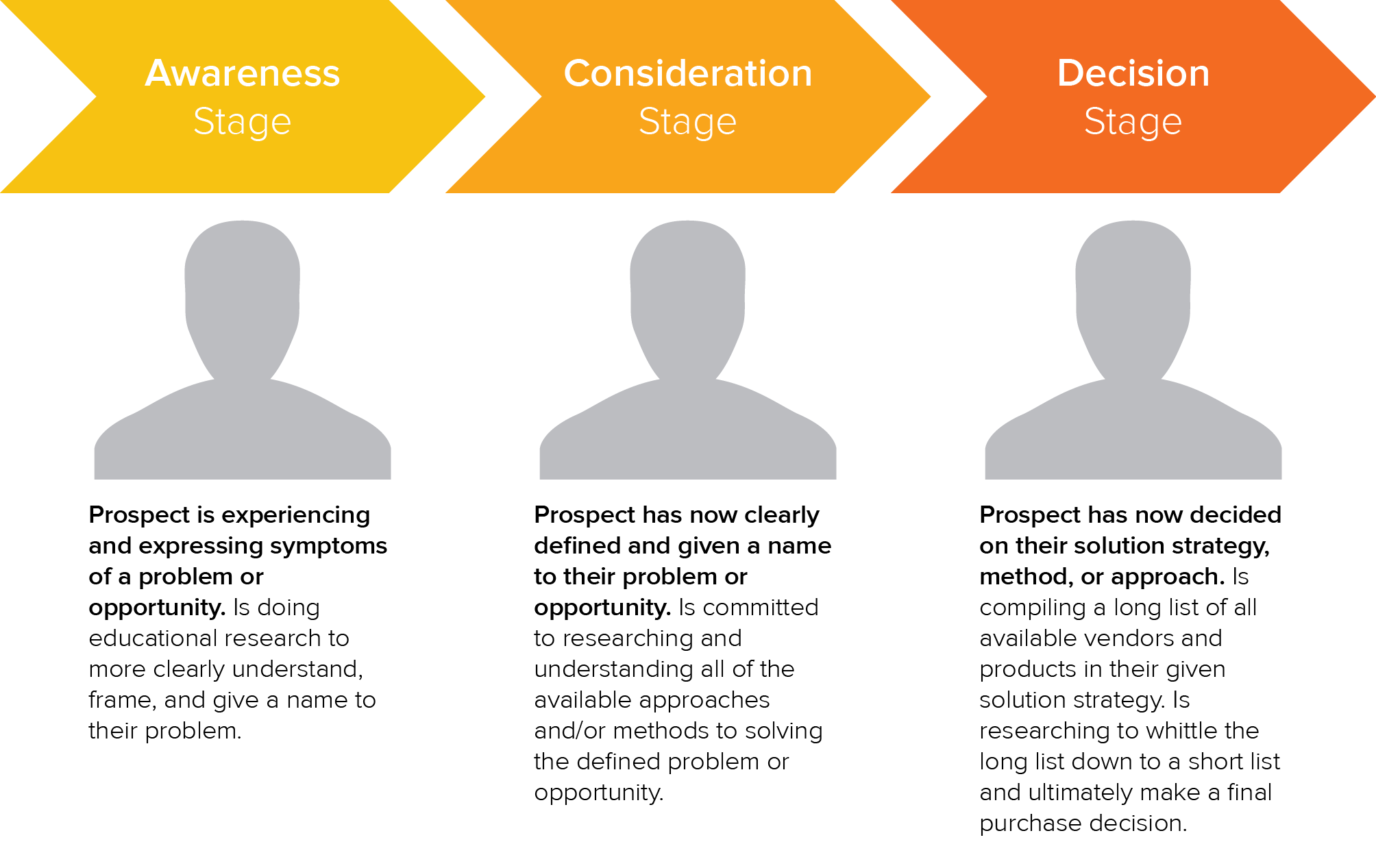
In the awareness stage, an engineer or buyer knows they have a problem: a part costs too much, the current supplier keeps missing deadlines, or a new design calls for a process they don’t have in-house.
In the consideration stage, they have defined the requirement and are comparing options: laser vs. waterjet, in-house vs. outsourcing, a local supplier vs. one in Central or Eastern Europe.
In the decision stage, they know exactly what they need and are choosing which suppliers receive the RFQ.
Each stage uses different keywords. For a sheet metal and laser cutting company, the map looks like this:
- Awareness: “laser cutting tolerances”, “sheet metal design guidelines”, “how to reduce sheet metal part cost”, “minimum bend radius stainless steel”, “powder coating vs wet paint”
- Consideration: “laser cutting vs plasma cutting”, “sheet metal fabrication supplier Europe”, “contract manufacturing Poland vs Germany”, “how to choose a laser cutting supplier”, “EN 1090 vs ISO 3834”
- Decision: “laser cutting service Bavaria”, “Blechbearbeitung Lohnfertigung” (sheet metal contract manufacturing), “CNC machining quote”, “steel fabricator EN 1090 EXC3”, “powder coating service large parts”
These stages correspond to the three levels of the manufacturing content funnel:
- Top of the funnel (ToFu): technical guides for engineers in the awareness stage
- Middle of the funnel (MoFu): comparison and supplier-selection content for the consideration stage
- Bottom of the funnel (BoFu): service, capability, certification and location pages that turn the decision stage into an RFQ
Most of your traffic will come from awareness and consideration keywords, because engineers ask a lot of technical questions. Most of your RFQs will come from decision keywords, which have tiny volumes but the highest intent.
Your job is to cover all three, so that the engineer who reads your tolerance guide today recognises your name when they search for a supplier next quarter.
Step 2: Build Your Topic List From Capabilities, Materials, Industries and Locations
Google ranks websites on their overall authority for a topic, not on individual keywords. A site that covers laser cutting from every angle (materials, thicknesses, tolerances, file formats, pricing, example projects) will outrank a general “we do everything in metal” site for laser cutting terms, even with weaker on-page SEO.
So before you open any tool, define the broad topics your website should be the authority on. For a metalworking company, they come from four dimensions:
- Processes: CNC milling, CNC turning, laser cutting, bending, MIG/TIG welding, steel structure fabrication, powder coating, assembly
- Materials: structural steel (S235, S355), stainless steel (1.4301, 1.4404), aluminium, Hardox, copper, brass
- Industries: automotive, agricultural machinery, rail, energy, machine building, construction
- Locations: your city and region, plus the countries you export to (Germany, Austria, Switzerland, Benelux, Scandinavia)
Combine the dimensions and you get topic clusters such as “CNC turning stainless steel”, “laser cutting aluminium for machine builders” or “steel structures Germany”. These are not your final keywords yet; they are the seeds you will expand in the next steps.
Two practical notes before you move on.
First, check your own brand keywords. Search your company name and its common misspellings and make sure your homepage, Google Business Profile and LinkedIn page fill the first results. Existing customers, auditors and new buyers all search for you by name before they send an RFQ.
Second, list the keywords in the languages your buyers actually use. In Germany, “CNC Fräsen” (CNC milling) is searched around 800 times a month, while the English “CNC machining services” gets about 100, and the English term is far harder to rank for because global platforms own it. If you sell to DACH, your keyword list needs German terms, not translations of English ones.
Step 3: Mine Google Search for Long-Tail Keywords
The cheapest keyword tool is Google itself. Three of its features will give you hundreds of long-tail keyword ideas in an hour.
Long-tail keywords are longer, more specific phrases with lower volume and lower competition. In manufacturing, they are where the RFQs hide.

Google Autocomplete
Type “laser cutting” without pressing Enter and Google completes it with the phrases people search for most: “laser cutting aluminium”, “laser cutting stainless steel”, “laser cutting near me”, “laser cutting service”.
Now add a modifier. “laser cutting for” reveals applications and audiences (“for signage”, “for architecture”, “for prototypes”). “laser cutting of” reveals materials and thicknesses (“of 20mm steel”, “of tubes”, “of stainless sheet”).
Then move the modifier in front of the keyword: “precision laser cutting”, “industrial laser cutting”, “cheap laser cutting”, “large format laser cutting”. Each variation opens a new set of suggestions.
Finally, try question words: “how thick can laser cutting”, “what tolerance laser cutting”, “why laser cutting instead of plasma”. Repeat the whole exercise in German, Dutch or whichever language your buyers use.
People Also Ask
Search your main topic and open the “People also ask” box. For “powder coating”, you will typically see questions such as “How long does powder coating last?”, “Is powder coating better than painting?” and “Can you powder coat aluminium?”.
Each question is a keyword and a potential article. Search a variation of your keyword (“powder coating steel”, “powder coating cost”) and the questions change, which gives you another batch of ideas.
Related Searches
Scroll to the bottom of the results page for related searches. Click on any of them and you get a fresh set of related searches, which lets you walk through an entire topic in ten minutes.
Not every idea will be worth targeting, but this is the fastest way to build a raw list of 200–300 keywords around each topic cluster from Step 2.
Step 4: Reverse-Engineer Competitors and Industrial Marketplaces
The fastest way to find proven keywords is to look at what already brings traffic to others.
Competitor Analysis With Ahrefs or Semrush
Enter a competitor’s domain into Ahrefs Site Explorer or Semrush and open the Organic Keywords report. Ignore their brand terms and look at the rest: which process, material and location keywords bring them visitors.
The Top Pages report is even more useful. It shows which of their pages get the most search traffic and the main keyword for each. If a competitor’s “laser cutting stainless steel” page brings 400 visits a month, that page and the keywords it ranks for are a template for yours.
Do this for five to ten competitors: local job shops, larger national players and the Central and Eastern European suppliers your buyers compare you with.
Industrial Marketplaces and Directories
In software, review sites like G2 own the transactional keywords. In manufacturing, that role belongs to marketplaces and directories: Europages, wlw (Wer liefert was), Techpilot, Orderfox, Kompass and on-demand platforms such as Xometry, Protolabs and Fictiv.
You will not outrank Europages for “CNC machining Germany” any time soon. But their category pages are a keyword goldmine:
- Open the category page for your process and note the related categories and the filters (material, industry, certification, region). Each one is a keyword.
- Paste the category URL into Ahrefs Site Explorer and open the Organic Keywords report to see every term that page ranks for.
- Open the profiles of the top suppliers in your category and note how the platform describes their capabilities, certifications and industries.
The same goes for on-demand platforms. The capability pages on Xometry or Protolabs (processes, materials, finishes, tolerances, lead times) show you exactly how engineers describe what they need.
Comparison and Alternative Keywords
Engineers compare processes and materials before they choose a supplier: “laser cutting vs waterjet”, “powder coating vs galvanizing”, “aluminium vs stainless steel enclosure”, “welded vs bolted steel structure”.
Filter a competitor’s keyword report for “vs” and you will find dozens of such terms. Each one is a consideration-stage article in which you can explain when the process you offer is the better choice.
There is also a manufacturing version of the “[competitor] alternative” keyword. Buyers who are unhappy with on-demand platforms search for “Xometry alternative Europe” or for direct suppliers of the same services. A page that explains why series production is better handled directly by a certified job shop than through a platform can capture exactly those buyers.
Step 5: Find the High-Intent Keywords That Produce RFQs
Bottom-of-the-funnel keywords are searched by buyers who are ready to send drawings. Their volumes are low, so most manufacturers ignore them.
Big mistake. These are the terms that fill your capacity.
For manufacturers, RFQ keywords fall into five groups:
- Service + geography: “CNC machining Bavaria”, “laser cutting service Vienna”, “steel fabricator near Rotterdam”, “Lohnfertigung Stuttgart” (contract manufacturing Stuttgart)
- Service + certification or standard: “EN 1090 certified steel fabricator”, “ISO 3834 welding company”, “IATF 16949 machining supplier”, “PPAP capable CNC supplier”
- Service + capability: “laser cutting 25mm steel”, “5-axis milling large parts”, “small batch CNC turning”, “powder coating up to 7 metres”
- Service + material: “stainless steel welding subcontractor”, “Hardox laser cutting”, “aluminium CNC machining supplier”
- Commercial modifiers: “CNC machining quote”, “laser cutting price per metre”, “sheet metal fabrication cost”, “request quote steel structures”
Certification keywords deserve special attention. For a purchasing manager at an OEM, “EN 1090 EXC3” or “ISO 3834-2” is not a detail; it is a filter that decides whether your quote is even opened. A dedicated page for each certification you hold, optimised for that certification keyword, is one of the cheapest sources of RFQs you can build.
The same goes for capability keywords. Engineers search by the constraint that is blocking them: sheet thickness, part size, tolerance, batch size, lead time. If your laser cuts 30 mm steel or your coating line takes 7-metre profiles, say so on a page optimised for that exact phrase.
Watch the intent behind head terms, too. “Pulverbeschichtung” (powder coating) gets about 9,700 searches a month in Germany, but most of them come from people who want to know what it is, what it costs or how to do it themselves. The RFQs sit in the modifiers: “Pulverbeschichtung Lohnbeschichtung” (contract powder coating), “Pulverbeschichtung Großteile” (powder coating large parts), “Pulverbeschichter in der Nähe” (powder coater nearby).
To find these terms, take each service from Step 2, combine it with the modifiers above and check the numbers in Step 6. In Germany, “CNC Drehteile” (CNC turned parts) has around 300 searches a month with almost no ranking difficulty, and “Lohnfertigung” (contract manufacturing) around 700. Those are exactly the numbers you want: modest volume, clear intent, low competition.
Step 6: Evaluate Search Volume, Clicks, Traffic Potential and Difficulty
By now you should have a list of several hundred keyword ideas. You cannot target all of them, so the next step is to evaluate and shortlist.
Plug the keywords into Ahrefs Keywords Explorer (or Semrush, or the free Google Keyword Planner) and look at four numbers for each one.
Search Volume per Country and Language
Check the volume in every market you sell to, not the global figure. A keyword searched 800 times a month in Germany may get 100 searches in Austria and 50 in Switzerland, and each market may use a different term.
Always add the local-language variants. “Laserschneiden” (laser cutting) has about 1,000 monthly searches in Germany; the English “laser cutting service” has about 100 there.
Clicks, Not Just Searches
Ahrefs also shows how many searches actually end in a click. When Google answers a question directly in a featured snippet or an AI overview (“how long does powder coating last?”), most searchers never visit a website.
Prefer keywords where most searches produce clicks. This is usually the case for supplier and service searches, where the searcher needs a company, not a definition.
Traffic Potential
The top-ranking page for a keyword usually ranks for dozens of related terms as well. “CNC Fräsen” (CNC milling) has about 800 searches a month in Germany, but the page ranking first for it receives roughly 3,300 visits a month from all the keywords it ranks for.
So when you compare keywords, look at the traffic potential of the top-ranking page, not only at the search volume.
Keyword Difficulty Relative to Your Site
Keyword Difficulty (KD) estimates how many backlinks you need to reach the top ten. The score only matters relative to your own website’s authority.
For a manufacturing website with little existing authority, a KD of 30 is hard. For an established site with hundreds of referring domains, KD 50 is routine.
The difference between languages is striking in industrial niches. In Germany, the English “CNC machining services” has a KD of about 80 because international platforms dominate it, while “CNC Drehteile” and “Lohnfertigung” sit close to KD 0.
If your site is new, build your service pages and blog around the low-KD local-language terms first. Reserve the competitive English terms for your homepage and main service pages, where you can build links over time.
Step 7: Check Search Intent and Map Every Keyword to a Page
You now have a shortlist. The last step decides what to build for each keyword.
Read the Search Results Before You Write
Search for the keyword and look at what Google ranks. For “CNC machining Germany”, the first page is mostly directories and suppliers’ service pages, so the right answer is a service page, not a blog post. For “laser cutting tolerances”, the results are technical guides, so the answer is an article. For “best powder coating companies”, the results are list posts, so optimising your homepage for it will not work.
Whenever you create content for a keyword, make sure the format matches Google’s understanding of the search intent. Otherwise you will not rank, no matter how good the page is.
Set Content Benchmarks
Open the top ten results and note their length, structure, images and the technical detail they include: tolerance tables, material lists, certifications, example projects, lead times.
Your page needs to be more complete and more specific than theirs. That means real photos of parts and machines instead of stock images, exact specifications instead of adjectives, and a clear path to an RFQ.
Map Keywords to Pages
Finally, assign every shortlisted keyword to one page type:
- Service pages for process keywords (laser cutting, CNC turning, powder coating)
- Capability and material pages for constraint keywords (thickness, part size, stainless steel, aluminium)
- Certification pages for EN 1090, ISO 3834, IATF 16949 and similar terms
- Industry pages for “machining for agricultural machinery” or “steel structures for logistics halls”
- Location pages for the regions and countries you serve
- Blog articles and guides for informational and comparison keywords, each linking to the relevant service page
Every one of these pages ends with the same thing: a short RFQ form and the option to upload a drawing. That is the point where keyword research turns into revenue.
For the writing and optimisation part, read our guides to on-page SEO for manufacturing websites and SEO content creation for manufacturing companies.
Ready to Turn Keyword Research Into RFQs?
Keyword research is a big topic, but the seven steps above are enough to build a list of 30–50 keywords that a manufacturing website can realistically rank for, even if the site is new.
Once you have the list, organise it into topic clusters, plan each page with a proper content brief and start with the RFQ keywords from Step 5, because they pay back fastest.
As your pages start ranking, Google Search Console will show you the exact queries buyers use to find you. Feed them back into this process every quarter, re-optimise the pages that are close to page one, and expand into new clusters. Our article on why SEO content matters for manufacturing companies explains how this compounds over time.
And if you would rather have this done for you, see how we approach SEO for metalworking companies or book a free consultation, and we will walk you through the keywords your buyers are searching for right now.