The purpose of SEO content is no longer to stack articles with keywords and anchor text and hope the technical tricks do the rest.
Today you have to achieve several things at once: satisfy the engineer’s or buyer’s query, do it with content that is authoritative and pleasant to read, and do it consistently enough that Google treats your site as the expert on your process.
Follow the five best practices below and your manufacturing website will grow its organic traffic and, over time, earn a sort of compounding interest on its technical content: RFQs from articles you wrote years ago.
So let’s start.
Table of Contents
Understand the User Intent
What is the searcher trying to learn, figure out or do when they type a phrase into Google? That is their intent.
When you can pinpoint the intent, you can write content that satisfies it.
As a rule of thumb, the more exhaustively and accurately a page satisfies the purpose behind the search, the more traffic it receives.
But ranking and getting the click is only the first step.
An engineer may click your article, but if it doesn’t match what they expected, they realise within seconds that it isn’t answering their question and go back to the results. Google picks up on that pattern and demotes you.
The key point: before writing, in fact before even picking the topic, understand the purpose behind the target keyword.
For some queries the intent is obvious.
“What is powder coating” is clearly informational, one of the four main types of search intent. The searcher wants the basics: what the process is, how it works, what it is used for.
The top results for that query all go broad: definition, process steps, materials, advantages over wet paint. They go broad because that is what the reader needs.
If, on the other hand, the query is “powder coating defects”, it would be a mistake to open the article with “What is powder coating”. The searcher already knows. They have orange peel or pinholes on a batch of parts and want to know why.
For that article, go straight to the list of defects, their causes and their fixes. Give the answer as early as possible, and Google rewards you with rankings.
The problem starts when the intent isn’t obvious. Marketers make an incorrect assumption and waste time and money writing the wrong piece.
Take “laser cutting stainless steel”. Is that a design engineer who wants to know whether stainless can be laser cut cleanly, at what thickness and with what edge quality? Or is it a buyer looking for a supplier who can cut stainless?
If you can’t tell at first glance, there are strategies you can use.
First, consult the search results for the query and analyse what ranks. Google gave those pages the top spots for a reason: they most likely answer the query better than anything else.
If the first page is mostly service pages, directories like Europages and on-demand platforms, the intent is commercial and you need a capability page with materials, thicknesses and an RFQ form. If it is design guides and technical articles, the intent is informational and you need a guide.
But don’t look only at the pages. If there is a video block, note what the videos show; process videos point to an informational query. And examine the ads: when suppliers are bidding on the phrase, buyers are searching it.
For “laser cutting stainless steel”, most markets show a mix: a couple of technical guides at the top, then supplier pages. The safe answer is a capability page that opens with the technical facts an engineer needs and ends with the quote form a buyer needs.
This is the most effective technique for working out intent. For other methods, Keyword Cupid’s guide on search intent is a good read.
The bottom line: if you want your content to rank, make sure it matches the search intent.
Intent determines the audience behind the keyword (design engineer vs. buyer) and should guide the format of the content (broad overview vs. deep dive, guide vs. capability page).
Matching intent better is also how a small job shop outranks a much bigger site. For a query like “types of sheet metal bending”, an article that covers exactly the bending methods, with a photo and a use case for each, beats a machine builder’s page that also covers the history of press brakes, the benefits of bending and their product line. The searcher asked one question; the page that answers exactly that question wins.
That is the power of search intent.
Create Well-Researched Content
Sadly, many content creators go about research all wrong: they copy the structure and sentences of high-ranking articles and tweak them slightly to make “their own” post.
Often the only thing that changes from one supplier’s article to the next is the company name at the bottom. That is not well-researched content.
It won’t outrank the competition, because it is only parroting what the other pages said.
Google can tell when content is rehashed and adds nothing new to the conversation.
Top articles can serve as a guide for structure and definitions, but you have to provide more value if you want to pass them. So how?
Research. Here is a two-step approach.
First, study the top-ranking articles for your query. Read them for context. Analyse what they do well; if you like their outline of H2s, that is fine to use as a foundation.
But the real question is: what are they missing? What can you include that serves the searcher’s intent better than they do?
Take the query “how to reduce the cost of laser-cut parts”. The top results are usually design guides from on-demand platforms. They give step-by-step tips, but they don’t show a real part before and after redesign, they don’t put a number on any of the tips, and they don’t explain how nesting, material choice and batch size interact on an actual quote.
If you want to compete on that keyword, providing exactly that missing information is how your article becomes the better candidate for the top spot.
Now you know what to find during your research. You have an aim.
The second step is to find that information through deep, first-hand research: photos, quotes, data and numbers you then comment on or summarise to support the article’s points.
Here are research methods a manufacturer can use to stand out:
| Interview experts | Ask your own production manager, welding engineer or quality manager. Ask the application engineers of your machine and material suppliers. Fifteen minutes each is enough. |
| Run polls | Run a LinkedIn poll among engineers and buyers: what drives up the cost of laser-cut parts in your projects? Use the answers in the article. |
| Read first-hand research | Read the standards (EN 1090, ISO 9013, ISO 2768), technical papers from universities and research institutes, and machine builders’ technical documentation. |
| Use your own images | Photograph the actual part, the drawing before and after, the edge at 3 mm and at 20 mm. Nobody else has these images. |
| Source original quotes | Ask customers, suppliers and trade associations for a sentence on the topic, or quote what they have already said publicly on LinkedIn or in trade magazines. |
| Consult your production data | Cost calculations, cycle times, scrap rates, lead times from your ERP. First-hand data is what Google and buyers love most. |
Take the time for a few of these and you will have collected additional value that enriches the content, helps the engineer reading it and sets your article apart.
It can then overshadow even the most authoritative platform’s guide in the results.
Sometimes you outrank others simply by matching intent better, but providing more value based on real research gets you there just as often.
So even if you are the expert on the process, don’t skip the research. It supplements your knowledge with data and examples, enriches the content and moves it up the results. We describe the whole method in our content research process for manufacturers.
Focus on Creating Evergreen Content
Evergreen content stays relevant for a long time and therefore performs better in search. It is content that is not seasonal or tied to news.
If you are creating content that should actually rank, and not just sharing company updates, evergreen is the way to go.
What does that mean in practice?
Prioritise topics that are not relevant for just one month or one year.
The report from this year’s trade fair loses its relevance the week the fair ends. An article titled “How to choose a laser cutting supplier” or “Laser cutting tolerances by material” stands the test of time, until the unlikely day nobody needs laser-cut parts anymore.
Look at the results for any technical query in your niche and you will find guides that are three or four years old and still ranking on the first page, alive and kicking.
In B2B, an engineer will read “sheet metal design guidelines” even if it was written in 2021, because the topic is evergreen. If there is no other page that is not just newer but also better, Google keeps ranking the older one.
In fact, ageing can help a page rank better, as it accumulates backlinks and authority over time.
So, apart from choosing evergreen topics, avoid making them obsolete by putting a year in the URL and title.
Titles are easy to update; URLs need redirects, so they are best set up right from the start and left alone.
Keep your URLs evergreen and keep the year out of them:
✅ www.company.com/blog/laser-cutting-tolerances
❌ www.company.com/blog/laser-cutting-tolerances-2024
If you update your articles regularly, a year in the title can work. We just want to save you the trouble.
As for which formats are most evergreen, Backlinko’s study of 3.6 billion articles found that list posts and how-to posts are the two most evergreen content formats. For a manufacturer, that means “7 design mistakes that make machined parts expensive” and “How to prepare a DXF for laser cutting”.
And which topics are evergreen? That depends on your processes. Start with the evergreen problems your buyers have: tolerances, cost, lead times, material selection, certifications, quality documentation. Those questions were asked ten years ago and will be asked in ten years.
Investing in evergreen rather than seasonal content is the difference between buying a house and a car. The house gains value over time; the car loses it quickly.
You want your content to grow in power, not decline because it stopped being news.
Make Your Content Engaging
Unfortunately, it is getting harder to grab and hold anyone’s attention. According to OptinMonster, the average person looks at a website for about 8 seconds before deciding it’s not for them.
That means you have to show quickly that your content is worth reading in detail.
More precisely, it means the content has to serve the reader’s intent, and it has to look like it will be easy to get through.
One of the main reasons an engineer bounces from a technical article is that it looks daunting: long paragraphs, few headings, no tables, no photos.
So avoid making your page look like the one on the left:

The readability of a page is inextricably linked to its ability to engage a reader, and engagement is tied to your SEO results.
So the aim is content that is educational AND easy to consume.
👉 EDUCATION + ENTERTAINMENT = EDUTAINMENT 👈
Because that is what people want, engineers included.
They want the information, and if they could, they would download it straight into their heads without the effort of reading. So at least make the reading part easy.

So how do you create that readability? Here are the most effective tactics.
First, put a table of contents near the top, especially if the article pushes 2,500 words. A table of contents is basically a list of jump links.
It lets the engineer jump straight to the tolerance table or the material section without scrolling. Starting where they like increases the chance they read the whole piece.
Use short paragraphs, four lines at most, with short, simple sentences. A good technical guide reads like a conversation with an experienced engineer, with a table where a table is needed and a photo where a photo says it faster.
Another readability tactic is using images, graphics, tables and quotes to break up the text. These elements give the reader a break and aid comprehension.
A photo of a part with the defect you are describing, for example, fastens the main point to the reader’s memory far better than three paragraphs.
And that is not the only benefit. Used correctly, these elements add value to the content while making it more engaging at the same time.
At Fortis, we know how much engagement matters for SEO results, so we teach every writer how to create it.
Our technical content aims to be high in educational value and easy to read, and we devised our own framework for that, called QRIES.
QRIES stands for everything a manufacturing article needs in order to be engaging:
| Q | Quotes from relevant experts: your engineers, your suppliers, your customers. |
| R | Research-based arguments: standards, studies, technical documentation. |
| I | Images for information visualisation: real parts, drawings, tables, charts. |
| E | Examples from real projects and real companies. |
| S | Statistics and numbers from your own production to back up the claims. |
So if you want better SEO results, don’t let your content be hard to read.
No matter how good the information is, it is in vain if readers don’t stick around long enough to give the article a chance.
Enrich your articles with QRIES elements and the time visitors spend on your pages goes up.
Google tracks user signals and takes notice. Your reward: better positions in the results.
Build Your Topical Authority
Topical authority is a website’s perceived expertise on a specific topic.
And how is that expertise determined? Largely by the amount and depth of content the site has on the topic.
The more you publish on a narrow topic, say laser cutting, the more authority Google ascribes to you in that space, and the higher every page on that topic ranks.
Writing in topic clusters is one of the best ways to build it: many unique articles on the same main topic, strategically interlinked.
To visualise this, here is a similar approach, HubSpot’s hub-and-spoke content model:
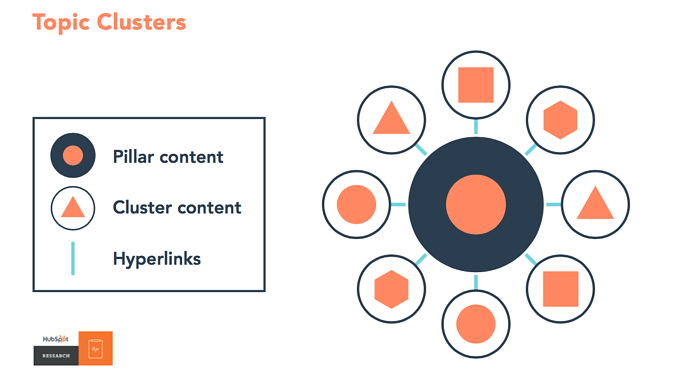
The hub-and-spoke model has one central piece of content that splinters into many others. To write in topic clusters, you don’t strictly need the hub.
You don’t need one pillar page in order to write 20 articles on one process, interlink them and rank them in the top 10. You just have to produce a lot of good content around one main keyword. (A pillar page, ideally your service page, makes the cluster stronger, but the cluster comes first.)
That is because it is no longer enough to publish one ultimate guide and expect to rank for the keyword.
You have to put in the effort to create a whole group of pages around that keyword:

Besides the obvious, writing in topic clusters is beneficial for manufacturing websites for two more reasons.
First, manufacturer websites are small. A homepage, a services page, a machine park, a contact page, maybe a references gallery, and that is it.
But Google loves big websites. Big websites win the SEO game.
So how do you make a job shop’s website bigger? Technical content. It scales easily, so your site can grow in content around each process you offer.
Second, writing in clusters lets you rank for many different keywords, because you cover more ground.
Every article ranks for more than one keyword, but here is the trick: they need each other’s support to build topical authority.
- No topic clusters, no topical authority.
- No topical authority, no top rankings.
So how do you go about it?
Imagine a sheet metal company knows that laser cutting is the topic it needs to own, because that is what most of its buyers search for.
Its content strategy should therefore cover this keyword until the site becomes the authority on the subject and ranks at the top.
For that to work, it needs as many good pages about laser cutting as it can produce. We are talking about 20–40 articles.
Here is what that list could look like:
- How to Prepare a DXF File for Laser Cutting
- Laser Cutting Tolerances: What to Expect by Material and Thickness
- Laser Cutting vs. Plasma Cutting vs. Waterjet: Which Process for Which Part
- Maximum Sheet Thickness for Fibre Laser Cutting by Material
- Laser Cutting Stainless Steel: Edge Quality, Oxidation and Cost
- Laser Cutting Aluminium: What Designers Need to Know
- 10 Design Mistakes That Make Laser-Cut Parts Expensive
- How Nesting Affects the Price of Laser-Cut Parts
- Laser Cutting Cost Calculation: What Drives the Price
- Kerf Width in Laser Cutting and How to Design for It
- Laser Cutting and Bending: Designing Parts for Both
- Tube Laser Cutting: Applications and Limits
- Fibre Laser vs. CO2 Laser: What It Means for Your Parts
- Laser Cutting Hardox and Other Wear-Resistant Steels
- Deburring and Finishing Options for Laser-Cut Parts
- Laser Cutting for Prototypes vs. Series Production
- How to Choose a Laser Cutting Supplier: 9 Criteria
- Laser Cutting Lead Times: What Is Realistic
- Laser Cutting Quality Classes: ISO 9013 Explained
- Common Laser Cutting Defects and Their Causes
- Laser-Cut Parts for Agricultural Machinery: Requirements and Examples
- Laser Cutting Small Batches: When It Makes Sense
- Laser Cutting Statistics and Market Trends You Should Know
Each of these articles not only supports the site’s effort to rank for “laser cutting”, it also ranks for many related keywords of its own.
The “defects” article ranks for laser cutting defects. The “supplier” article ranks for laser cutting supplier. The “tolerances” article ranks for laser cutting tolerances, the most searched technical question about the process.
The trick is to make each article unique in information and structure. Every piece needs its own angle.
So there you go. If you want to rank for laser cutting, cover the topic from every angle, deep and wide, and you build topical authority.
Rinse and repeat for every other process you want to rank for: CNC machining, welding, steel structures, powder coating.
You will also show Google’s algorithm that you truly are the expert on it, and be rewarded with great positions in the results.
Conclusion
The best practices above are the fundamental principles for creating content that drives traffic to a manufacturing website and turns it into RFQs.
They satisfy both the platform you want to conquer (Google), by making you a topical authority, and the people using it (engineers and buyers), by matching their intent and giving them content worth reading.
No amount of backlinks or LinkedIn promotion can compensate for ignoring these principles. Only together with useful, buyer-focused content do those tactics deliver results.
So cover the basics before you try to power up your content game. Our guide to SEO for manufacturers shows how these five practices fit into the bigger picture.