
How do you create content that ranks in Google and also convinces the engineer or purchasing manager reading it to send you an RFQ?
Most manufacturing companies struggle with this. Their websites either have no content beyond a “News” page with trade-fair photos and the new machine, or they publish keyword-stuffed articles that nobody reads. Neither approach wins orders, and we have written before about why a manufacturing blog stops generating leads.
The reason is usually the same: the company either treats content purely as an SEO exercise or ignores search entirely and writes for its own pride.
In this article, we share six SEO content best practices that help manufacturing companies, from CNC machining and laser cutting to welding, steel structures and powder coating, create content that builds authority with OEM buyers and ranks for the keywords that lead to RFQs.
Keep reading to learn more.
Table of Contents
1. Develop Buyer Personas for the Engineers and Purchasing Managers You Sell To
You cannot create useful content without knowing who you are writing for.
This is why developing buyer personas is a critical part of creating SEO content for manufacturing companies.
What is a buyer persona?
It is a profile of your ideal reader and buyer that you can draw from to plan your SEO and content marketing strategy.
For a job shop, there are usually two or three personas, and they read very differently:
- The design engineer who specifies the part. They care about materials, tolerances, process limits and design-for-manufacturing questions, and they search for technical answers.
- The purchasing manager or strategic buyer who selects suppliers. They care about certifications, capacity, lead times, price stability, supply risk, geography and how easy you are to work with.
- The quality manager, who shows up later with audit questions: traceability, material certificates, measurement reports, PPAP.
A persona contains the details that help you understand each of them: role, industry, company size, what they are responsible for, what they search for, their questions, their objections, and what “a good supplier” means to them.
Think of it as a compilation of all your audience research. There is no fixed template, but here is a sample persona to give you an idea of what it looks like:

Once your personas are ready, use them when performing keyword research for manufacturers or writing a new piece of content.
But how do you research your audience in order to build them? Here are a few methods.
Customer Interviews
If you already have OEM customers, talk to them. Why did they choose you, what did they check before sending the first RFQ, what almost stopped them, and did you deliver what they expected?
Ask both the buyer and the engineer. Their answers will differ, and both will give you the bulk of what you need for an accurate persona.
Talk to Your Sales, Quoting and Quality Teams
What do buyers ask in every RFQ? Why do you lose quotes? Which problems keep appearing on customer drawings? What do your customers’ auditors demand?
Your quoting inbox is a goldmine. Every RFQ email contains the exact language buyers use, and every lost quote tells you which objection your content should answer next.
Study Your Competitors’ Content
Search Google for your primary service and market, for example “laser cutting service Germany” or “CNC Lohnfertigung” (CNC contract manufacturing), and analyse who ranks: platforms, directories and competitors.
Which topics do the competitor sites cover? What do their guides look like? What do they publish on LinkedIn that gets engagement from engineers?
This is an easy way to find the topics your audience already wants to read about.
Dive Into Engineering Forums and LinkedIn Groups
Engineering forums such as Practical Machinist, Eng-Tips and CNCzone, subreddits like r/Machinists and r/Welding, and industry-specific LinkedIn groups contain priceless insights about the problems engineers actually have with suppliers, materials and tolerances.
A few Google searches in your language will surface the relevant communities. Browse them, follow a couple of quality discussions, and note the questions that come up again and again. Each one is a content idea.
Check Marketplace Profiles and Reviews
In manufacturing, first-hand customer feedback lives on Google Business Profiles, on directories such as Europages, wlw and Kompass, and on the profiles of on-demand platforms.
Look your competitors up and read what their customers praise and complain about: communication, lead times, quality, documentation.
Pay attention to the two-star and three-star reviews. They show the gaps in your competitors’ offers that your content can address directly, for example “we send a measurement report and 3.1 material certificate with every batch”.
These sources will give you more than enough information to build personas that genuinely reflect the people who send you RFQs.
2. Target Long-Tail Technical Keywords to Build Authority
Most manufacturers start their SEO strategy by targeting head terms such as “CNC machining” or “laser cutting”, which are dominated by on-demand platforms, directories and large suppliers.
That is not the best way to get results.
When your site is new and does not have the same authority as those competitors, targeting long-tail keywords is far more profitable.
What are long-tail keywords? They are keywords of three or more words. Think of them as phrases describing a specific need.

Research shows that nearly 70% of all online searches are long-tail. They do not have the search volumes of the head terms, but they describe a specific need, which is why they convert better.
In manufacturing, the long tail is where the RFQs are: “laser cutting 20 mm stainless steel”, “small batch CNC turning aluminium”, “EN 1090 EXC3 steel fabricator Austria”.
There are three reasons why long-tail keywords have a much higher ROI than competitive head keywords:
- Long-tail keywords have low competition, so you can rank for them with well-made content. It is far easier to rank for “5-axis CNC machining of aluminium housings” than for “CNC machining”.
- The search intent is much clearer, which simplifies content creation. “How to reduce the cost of laser-cut sheet metal parts” tells you exactly what to write; “laser cutting” does not.
- You can target several related long-tail keywords in the same piece, which adds up to real traffic even when each keyword only gets 30 searches a month.
Most long-tail keywords are informational: they are engineers’ questions about your processes, materials, tolerances and design rules.
By publishing content that answers those questions better than anyone else, you establish your company as the authority on your process and put your name in front of engineers long before they need a supplier.
So how do you find relevant long-tail keywords? Two methods cover most of it.
Google Search
The simplest method is Google Autocomplete. Type your main process into Google and look at the suggestions before you press Enter.
For “laser cutting”, you will typically see suggestions such as “laser cutting aluminium”, “laser cutting thickness”, “laser cutting tolerances” and “laser cutting vs plasma cutting”. Pick one of them, for example “laser cutting tolerances”, and repeat the exercise to get another layer of more specific phrases.
Then add prepositions and question words (“laser cutting for”, “laser cutting of”, “how thick can laser cutting”), and move the cursor to the start or the middle of the keyword to open up new angles. Each variation gives you a fresh set of suggestions.
The “People also ask” box and the related searches at the bottom of the results page add the questions engineers actually type. Repeat all of this in German or whichever language your buyers use: “Laserschneiden Toleranzen” (laser cutting tolerances) and “Laserschneiden Blechdicke” (laser cutting sheet thickness) are different keywords from their English equivalents.
Not all of the ideas will be relevant. Pick the ones that match your capabilities and evaluate them in an SEO tool, as described in our keyword research process for manufacturers.
Competitor Analysis
You can also find proven long-tail keywords by checking what your competitors already rank for in Ahrefs or Semrush.
The most useful targets are not other job shops but the on-demand platforms. The design guides and material pages of Xometry, Protolabs or Hubs rank for thousands of technical long-tail keywords. Run their resources or design-guide sections through the Organic Keywords report and you will find dozens of questions you can answer better, with your own photos and numbers.
Finally, check your own Google Search Console. The queries for which your site already gets impressions but few clicks are long-tail keywords you can win with a dedicated page.
3. Create Benefit-Driven BOFU Content That Leads to RFQs
The goal of manufacturing SEO content is to attract search traffic and convert it into RFQs. To achieve that, you need bottom-of-the-funnel (BOFU) content: the pages a buyer reads right before sending drawings.
Here is the difference.
The informational content from the previous section does not sell. It answers the engineer’s questions about tolerances, materials and design rules, and it targets people who are still working out how to make a part.
BOFU content talks directly about your capabilities and shows how they solve the buyer’s problem. It targets people who know what they need and are choosing a supplier, so it is built around commercial keywords: “laser cutting service”, “CNC machining supplier Germany”, “Lohnfertigung Schweißen” (contract welding), “EN 1090 steel structure fabricator”, “powder coating large parts”.
These keywords do not have much traffic, but they convert far better, because the searcher has drawings ready.
For a manufacturer, BOFU content means:
- Service and capability pages with your machines, materials, thickness ranges, tolerances, batch sizes, certifications and lead times (see our guide to on-page SEO for manufacturing websites).
- “How we work” pages: your RFQ process, what to include in a drawing, quotation turnaround, sample runs, and the quality documentation you supply (measurement reports, 3.1 material certificates).
- Industry and application pages: “sheet metal parts for agricultural machinery”, “stainless steel welding for food processing equipment”.
- Reference projects with numbers: part, material, batch size, tolerance achieved, lead time.
- Comparison pages: your process vs. the alternatives, outsourcing vs. in-house, a certified European supplier vs. Asia.
Take a page titled “Laser cutting of Hardox 500 up to 20 mm for agricultural machinery”. It explains why the material is difficult, which machine you cut it on, the tolerances and edge quality you achieve, how you deburr and coat the parts, shows one project with photos, and ends with an RFQ form. That is BOFU content, and it will rank for a keyword that only a handful of buyers search each month, every one of them worth having.
The key is to write it from the buyer’s perspective. Do not sound too enamoured with your machines. “We are proud of our new 12 kW fibre laser” is about you; “what a 12 kW laser means for your parts: 30 mm steel, cleaner edges, shorter lead times” is about them. Readers are looking for solutions, not equipment.
Show how your capabilities solve their problems with step-by-step material: a design-for-manufacturing checklist, a sample cost calculation, a before-and-after of a part you re-engineered for cheaper production. That builds authority and produces RFQs at the same time.
4. Dominate Your Niche With High-Authority Long-Form Content
Creating high-quality content is crucial for driving search traffic and turning it into RFQs. But quality alone is not enough.
One of the most important SEO content best practices is to publish high-authority, long-form content consistently. For a metal shop, “consistently” does not mean five posts a week; it means one solid technical guide a month, every month.
Why? Because the more often you publish substantial content, the more keywords you can target. Long-form content also ranks for multiple long-tail keywords and their variations at once, which drives additional traffic.
And finally, in-depth content gets more backlinks, from industry portals, trade associations and technical universities that would never link to a news post about your summer party.

That does not mean content length is a ranking factor. Google’s John Mueller has stated clearly that the number of words on a page has nothing to do with rankings:

He is right. Length itself is not a ranking factor. But when you write longer content, you naturally cover more keywords and their variations, and, as the Backlinko study shows, you earn more backlinks, which are among the strongest ranking factors.
So do not write to hit a word count. Your goal is to satisfy the searcher’s intent and answer their question more comprehensively than your competitors. For technical topics, that means tables, drawings, photos of real parts and numbers from your own production, not more adjectives.
Manufacturers can publish several types of long-form content to target new keywords and engage engineers. Here are the most effective formats.
How-to Posts and Design Guides
How-to content is the most popular B2B format because it teaches the reader how to achieve a specific goal: “How to design sheet metal parts for laser cutting and bending”, “How to prepare a DXF file for laser cutting”, “How to choose the right stainless steel grade for outdoor use”.
Design guides are the easiest way to offer value to engineers and demonstrate your expertise in one go. They also get bookmarked and shared inside engineering departments, which is exactly where you want your name to be.
Comparisons [Process vs. Process, Material vs. Material]
Most buyers compare options before they choose a supplier, so it is important to rank for the comparison keywords in your niche: “laser cutting vs waterjet vs plasma”, “powder coating vs hot-dip galvanizing”, “S235 vs S355”, “MIG vs TIG welding”.
This type of content is valuable for buyers who are still deciding how a part should be made. Written honestly, with a clear section on when each option makes sense, it brings you exactly the buyers your process serves best, and it ends with a link to your service page for the one you offer.
Alternatives Posts
Buyers routinely look for alternatives to the options they already know. In manufacturing, that means two searches worth targeting: alternatives to on-demand platforms for series production (“Xometry alternative Europe”), and European alternatives to Asian suppliers as companies nearshore their supply chains.
An article that compares lead times, logistics costs, EN 1090 or CE-marking requirements, communication and quality documentation, and positions your company as the direct alternative, captures buyers at the exact moment they are ready to switch.
Case Studies and Reference Projects
Case studies give buyers an inside look at how you work and provide social proof. A written reference project covers the part, the customer’s industry (and the customer’s name, if allowed), the challenge (tolerance, deadline, difficult material), what you did, and the result in numbers: lead time, scrap rate, cost saved.
Written case studies rank for long-tail keywords and get quoted in supplier evaluations. A photo gallery labelled “References” does neither.
Hopefully this list proves that you will not run out of ideas for long-form content. It is one of the most powerful ways to become the supplier name engineers in your niche recognise.
5. Structure Your Content for Engineers Who Scan
Dwell time is a critical yet often overlooked SEO signal.
It represents the time a user spends on a page after clicking a search result, before returning to the results page.
Say an engineer searches for “laser cutting tolerances”, clicks your page, finds a wall of marketing text about your tradition of quality, and goes back to Google after ten seconds. Do that often enough, and Google concludes your page does not answer the question. Your rankings drop.
This is why the format of your content is also among the essential SEO content best practices. The right format keeps the reader on the page, satisfies their intent faster and helps your rankings.
Here is how to format technical content.
Inverted Pyramid Approach
Journalists use the inverted pyramid to capture attention immediately: the most critical information goes at the top.

For a page on laser cutting tolerances, that means the tolerance table comes first, right under the introduction, followed by the explanation of what affects it (material, thickness, part size, machine), and finally the background for readers who want to go deeper.
The engineer gets the number they came for in the first screen, and stays for the rest.
Examples, Data, Photos and Drawings
If you want engineers to trust your advice, back every claim with numbers: measured tolerances, cycle times, cost examples, the thickness you actually cut last week.
Similarly, photos of real parts and machines, drawings, measurement reports and short process videos make your content more credible and keep visitors on the page longer than any stock photo.
Research shows that content with illustrations and images is easier to understand than plain text:

You probably know this from reading supplier websites yourself. The ones with a real photo of the part and a table of specifications are the ones you remember.
Formatting
Here is an insider secret. Nobody really reads your content; they scan it for the information they want. Engineers do this more than anyone.
To make your content scannable, use short paragraphs of two to three lines, tables for specifications, bullet lists for procedures, and descriptive subheadings such as “Maximum sheet thickness by material” instead of “Our capabilities”. Highlight the key specs in bold.
And place a “Request a quote” link after the section where the reader has enough information to decide, not only at the bottom of the page.
6. Elevate Your Rankings With a Planned Internal Link Structure
Internal links are links within your content that point to other pages on your site. They are crucial for rankings because they help Google crawl your site faster and distribute authority to your most important pages.
Instead of adding internal links at random, follow a planned structure. In SEO content terms, this is called the hub-and-spoke or topic cluster model:
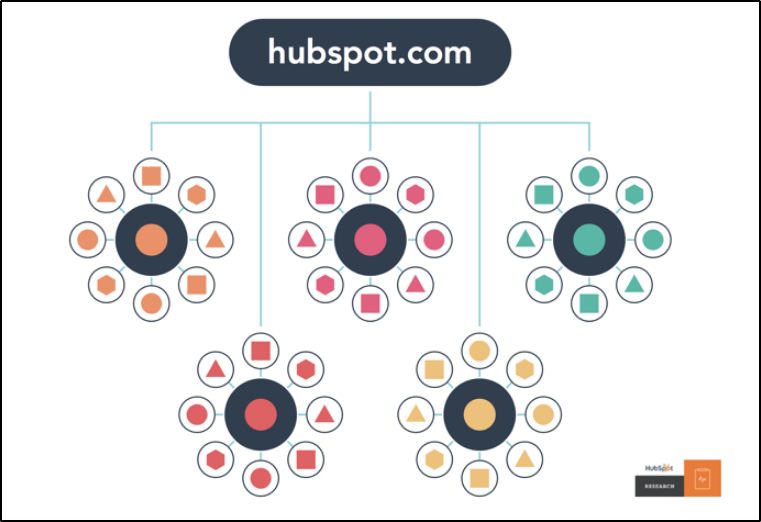
Each cluster has a pillar page. For a manufacturer, the pillar is a BOFU page: your service page for laser cutting, CNC machining, welding or powder coating.
Around that pillar, you publish supporting articles on related questions. Each article links to the pillar page, and the pillar links back to each article.
Take a powder coating cluster. The pillar is your powder coating service page: line dimensions, pre-treatment, RAL colours, certifications, lead times, RFQ form. The supporting articles answer the questions around it: powder coating vs. galvanizing, how long powder coating lasts outdoors, surface preparation before coating, maximum part size, powder coating aluminium, choosing the right RAL colour and gloss level.
Each of those articles links only to its pillar and to its sibling articles, and the pillar links to all of them. Build the same cluster for every service you offer.
What is the benefit? First, the supporting articles target informational keywords, so it is easier to earn backlinks to them from industry sites and universities. Since every supporting article links to the pillar, that authority flows to the service page that actually generates RFQs, and it ranks higher.
Second, topic clusters build your topical authority in Google’s eyes. Google starts treating your site as the authority on powder coating, or laser cutting, or steel structures, and new content in that cluster ranks faster.
Extend the same logic to your reference projects and certification pages: link each project to the services and materials it used, and each service page to the certifications that apply.
Is Your Manufacturing Website Using These SEO Content Best Practices?
The competition for industrial keywords is real: on-demand platforms, directories and established suppliers with years of content behind them. You cannot expect to rank for your target keywords by publishing news whenever there is a new machine to photograph.
As this article shows, creating content that drives organic traffic and RFQs requires a consistent, coherent strategy: personas for the engineers and buyers you sell to, long-tail technical keywords, BOFU pages, long-form guides, a format built for scanning, and a planned internal link structure.
These six SEO content best practices are the starting point for your manufacturing content strategy.
If you would like to discuss how they apply to your company, see how we do SEO for metalworking companies or schedule a free consultation call.