Content marketing is about attracting and engaging the people who buy from you. But what if you make brackets, turned parts, or steel structures? Can you write compelling content about “boring” stuff?
Good content brings buyers to your website, builds trust in your company before anyone has talked to you, and, eventually, turns into RFQs.
Creating fun content is easy if you sell cosmetics or video games.
But how do you build a content marketing strategy when your industry is CNC machining, laser cutting, welding, or powder coating?
Consistently producing compelling content about tolerances, sheet thicknesses, and coating systems seems somewhat challenging, right?
Not really.
“Boring” is a marketer’s word. To a purchasing engineer whose supplier just missed a delivery, a page that says exactly what tolerances you hold and how fast you quote is the most interesting thing on the internet.
Your industry exists for a reason. Somebody needs what you make, and that somebody is searching for it right now. You just have to know how to deliver the information.
The good news is that the bar is low. Most of your competitors have a homepage, an “About us” page from 2014, and a gallery of machines without names. The following tips will help you do better than that.
Table of Contents
Know Who Actually Reads Your Content
Let’s assume you already know your target market: machine builders in Germany, construction companies in the Nordics, medical device makers in Switzerland, or whichever industries you serve.
The people who read your content are not other manufacturers. They are purchasing managers, procurement engineers, design engineers, and project managers at those companies. Each of them arrives with a different question.
In practice, almost every question a buyer types into Google falls into one of three groups:
- Capability questions: “Can you machine Inconel?”, “Do you do tube laser cutting?”, “Maximum part size for powder coating?”
- Technical questions: “What tolerance can CNC milling achieve?”, “Which stainless steel for outdoor use?”, “What is EN 1090 execution class 2?”
- Commercial questions: “Lead time for small-batch machined parts?”, “Minimum order quantity?”, “Do you ship to Germany?”, “Do you have ISO 9001?”
Your content marketing strategy is simply a plan to answer these three groups of questions better than any competitor, in the order buyers ask them.
You don’t need a social media listening tool to find the questions. You need four sources you already have:
- Your RFQ inbox. Read the last 50 inquiries. The questions buyers ask before they send a drawing are your first 20 article topics.
- Your sales engineers. Ask them what they explain on every second call. That explanation is an article.
- Google itself. Type “laser cutting” and read the autosuggest and “People also ask” boxes. Those are real buyer questions, in the buyer’s words.
- Google Search Console. If your site is a few years old, it already shows which queries bring people to you. Most manufacturers never look.
The average B2B buyer consumes 13 pieces of content before choosing a supplier. If none of those 13 are yours, you are not on the shortlist, no matter how good your machines are.
Solve the Buyer’s Problem, Not Yours
You know who your ideal customer is, so you probably know why they might be interested in your company.
You can also guess what problems they are facing, and many of those problems go beyond your machines.
Anticipate those problems and create practical content that solves them, even when the solution isn’t “buy from us.”
A few examples of what that looks like in a “dull” industry:
- A powder coating shop writes “How to prepare steel parts for powder coating (and what happens when you don’t).”
- A CNC machining company writes “7 drawing mistakes that make your machined parts 30% more expensive.”
- A steel structures fabricator writes “EN 1090 execution classes explained for buyers and architects.”
- A welding company writes “MIG vs. TIG welding: which one your assembly actually needs.”
None of these titles sound exciting to a marketer. Every one of them is exactly what an engineer with an open drawing searches for on a Tuesday afternoon.
And every one of them ends with the same quiet conclusion in the reader’s head: these people know what they are doing.
Write Like Your Best Sales Engineer Talks
The fact that your readers work in industry doesn’t mean they are as deep in your process as you are.
A purchasing manager knows what a tolerance is. She may not know why ±0.01 mm costs three times more than ±0.1 mm. Your article should tell her, in one sentence.
Technical terms are fine. Jargon is not. The difference: a technical term is something the buyer needs to know; jargon is something you say to sound like an expert.
Keep it as simple as possible.
Remember that many of your readers are reading in their second language. A German buyer reading your English page, or a Dutch engineer reading your German one, will thank you for short sentences and one idea per paragraph.
The best test: read the article to a sales engineer and ask whether that is how they would explain it to a customer on the phone. If they would say it differently, write it the way they would say it.
Find an Angle a Buyer Would Forward to a Colleague
You probably have a general idea of the topics you could cover by now. To make the content genuinely useful, you need a specific angle the reader perceives as relevant to their situation.
A generic page called “Our laser cutting capabilities” is nowhere near as engaging as “Laser cutting 25 mm mild steel: what edge quality to expect, and when to switch to plasma.”
The first step in finding an angle is crafting a specific title. Angles that work again and again for manufacturers:
- Comparisons: laser vs. waterjet, powder coating vs. hot-dip galvanizing, aluminium 6082 vs. 7075
- Cost drivers: what makes a machined part expensive, and what the buyer can change on the drawing
- Standards explained: ISO 2768, EN 1090, ISO 3834, 3.1 material certificates, in plain language
- Mistakes: the five things that delay an RFQ, the drawing details that get parts rejected
- Behind the quote: what you check before you send a price, and why
Suppose you run a sheet metal shop. Instead of writing about sheet metal fabrication in general, list the design rules that make a bent part cheaper: minimum bend radius, hole distance from the edge, standard sheet sizes. That article gets forwarded from the buyer to the designer, and now two people at the customer know your name.
Tell the Story of a Part
A few principles of psychology can help you create content that a buyer remembers.
The human brain recognizes stories as patterns. When we read a story, we picture ourselves inside it, and our brains respond in a similar way to how they react to reality.
In manufacturing, storytelling doesn’t mean a brand video with a piano soundtrack. It means the story of a part.
Instead of writing “we offer 5-axis machining,” write “How we machined a 400 mm titanium housing for a Swiss machine builder in 11 days”: the drawing arrived on a Tuesday, the problem was a thin wall that vibrated, the solution was a change of fixture and toolpath, the result was a part that passed CMM inspection on the first try.
Before and after photos, the customer’s industry and country (anonymized if you must), the numbers. That is a case study, and it is the most persuasive content a manufacturer can publish.
You can also help readers relate by using simple analogies to explain particular concepts.
Oftentimes a topic seems off-putting and dull because it’s too complex.
Explaining tolerance grades to a non-engineer works better if you compare them to the difference between a door that closes and a door that seals. Explaining why a 3.1 certificate matters works better if you describe the audit where somebody asked for it and nobody had it.
Pay attention to tone. Humor is optional in an industrial article; honesty is not. If a process has limits, say so. A buyer who reads “we don’t recommend powder coating for parts that see constant abrasion” trusts you more, not less.
Show Your Work
This is the advantage manufacturers have over every software company and every agency: you make physical things, and physical things can be photographed.
Google’s quality guidelines reward what it calls E-E-A-T: experience, expertise, authoritativeness, and trustworthiness. A marketing agency has to fake the first one. You have a shop floor full of it.
Put it in the content:
- Real photos of real parts, with a caption that says the material, the process, and the tolerance held
- Short phone videos of the machine running the job (30 seconds is enough)
- Your certificates, with dates, on a page Google can index, not buried in a PDF
- The name and photo of the engineer who wrote or checked the article
- Numbers from your own shop: typical lead times, quote turnaround, first-pass yield, machine count
This matters more every year, because buyers no longer only search on Google. They ask ChatGPT and Google’s AI Overview questions like “CNC machining suppliers in Poland with ISO 9001 and 5-axis capacity.” AI engines answer those questions by citing pages that state specific, checkable facts. Vague brochure language never gets cited; a page with your machine list, tolerances, and certificates does.
Stay to the Point
When you know a process inside out, you are likely to write about it in too much detail.
You get carried away by every interesting little fact, and the company history somehow ends up in an article about bend radii.
That’s why you have to edit.
One topic per article. Keep the machine list on the capability page, the history on the About page, and the extra ideas for the next post. You’ll need them.
Avoid fluff and repetition. A buyer who has to scroll past three paragraphs about “our commitment to quality” to find your maximum sheet size will simply open the next supplier’s website.
Format for the Way Engineers Read
In content marketing, the first impression is everything.
If a buyer lands on your website and sees a giant block of grey text about a complex topic, they leave within seconds.
People don’t actually read web content; they skim and scan. Engineers skim even harder, because they are usually looking for a single number.
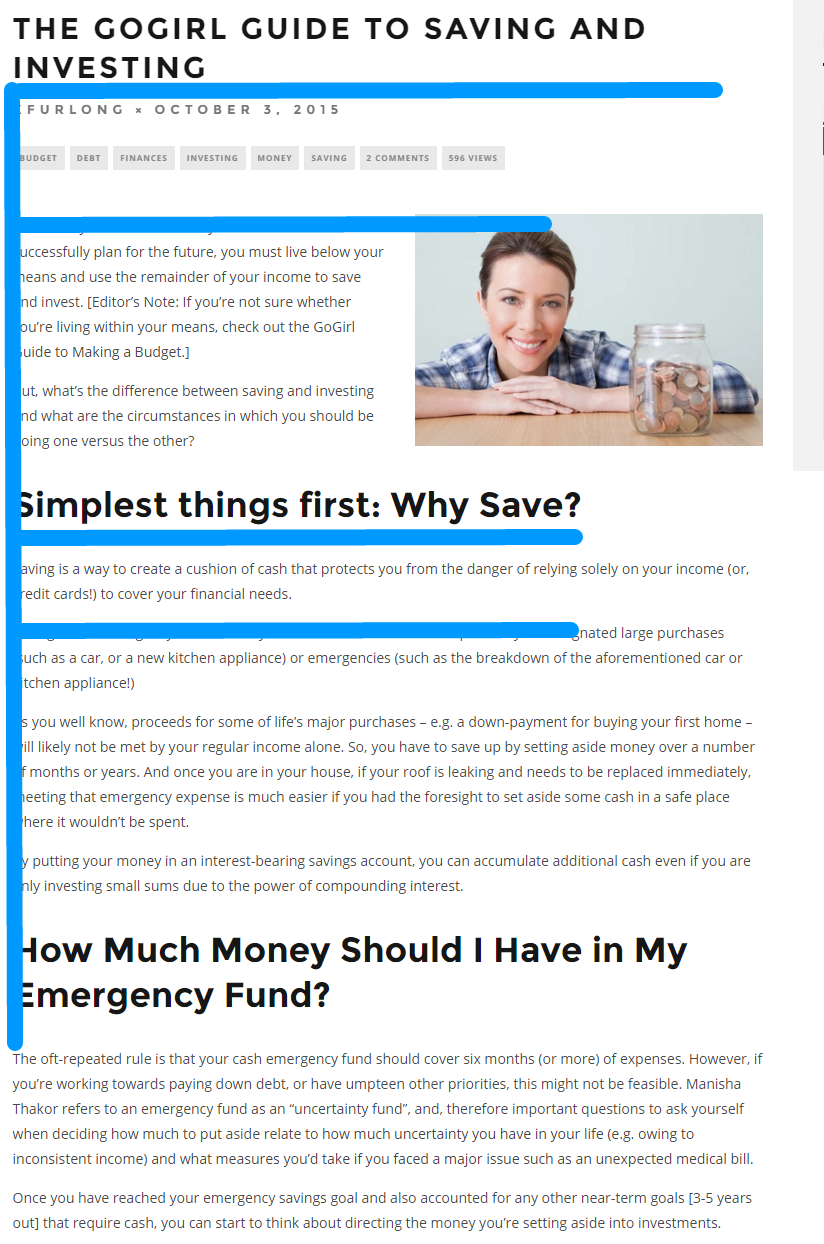
Readers follow the so-called “F-pattern” to find the useful parts of a page: they scan the top of the page, then move down the left side until something grabs their attention and makes them read a sentence or two.
Format your content for that behavior:
- Paragraphs of two to three sentences, short sentences inside them
- Subheadings that name the process, material, or specification, so a scanner can find their question
- Tables for anything with numbers: tolerances, sheet thicknesses, materials, lead times, machine travels
- Bullet lists for certifications, capabilities, and checklists
- Real photos and short videos instead of stock photos of robots and handshakes
- Downloads where they help: a design-for-manufacturing checklist, a drawing template for RFQs
Finally, end every article with a call to action that fits where the reader is. For a technical article, “send us your drawing and we’ll tell you within 24 hours if we can make it” beats “contact us” every time.
Get the Content in Front of Buyers
Publishing on your blog is step one. In a “dull” industry, distribution is where most manufacturers stop, and where the real advantage is.
- Search. Every article targets a question buyers actually type. Our guide to SEO for manufacturers covers how to find and rank for those questions.
- LinkedIn. Your buyers are there. Post the article from the owner’s or sales engineer’s profile with one honest sentence about why you wrote it, not from a company page nobody follows.
- Email to existing customers. A quarterly email with two useful articles keeps you in the buyer’s mind between orders, and gets forwarded to colleagues.
- Trade media and directories. Industry portals and supplier directories in your target countries accept technical articles and list capabilities. Those listings are also where AI engines look when they compile supplier lists.
- Sales. Give your sales engineers the links. Answering a buyer’s question with “here is an article we wrote about exactly that” shortens the next call.
Measure RFQs, Not Likes
Content marketing in a consumer industry is measured in shares and followers. In manufacturing, those numbers are close to meaningless.
Measure what pays the wages: RFQs submitted, drawings uploaded, phone calls from the website, and which article the buyer read before contacting you. Google Search Console tells you which questions bring visitors; your RFQ form tells you which articles bring buyers.
Give it time. Industrial buying cycles run six to twelve months, and an article published today will still be answering questions, and bringing inquiries, in three years.
Conclusion
Content marketing works in every industry, and it works especially well in the ones everybody calls dull, because almost nobody there is doing it properly.
Answer the capability, technical, and commercial questions your buyers ask. Write the way your best sales engineer talks. Show real parts, real numbers, and real people. Format for scanners, and end with a call to action that asks for the drawing.
If you want to go deeper, read our 13 SEO content creation tips for manufacturing companies, and if your blog already exists but brings nothing, start with the 4 reasons a manufacturing blog doesn’t generate leads.
Monitor what your buyers engage with, learn from the competitors and industry leaders who publish well, and keep adjusting. The engineers searching for you at 2 p.m. on a Tuesday will notice.