For many manufacturing companies, industrial suppliers, and contract manufacturers, the business development playbook has looked the same for decades. Growth relies almost entirely on word-of-mouth referrals, attending annual trade shows, nurturing long-standing industry relationships, and executing traditional outbound sales.
While these traditional channels remain valuable, many managing directors and export managers overlook a powerful asset they already own: their company website.
Specifically, the company blog is frequently underused or dismissed as a minor marketing task.
When executed correctly, high-quality technical content does not just sit on a page; it serves as a long-term source of visibility and inquiries. It helps procurement teams and engineering buyers discover your technical capabilities, builds deep trust before a prospect ever speaks to your sales team, and ensures your business shows up in modern Google and AI search tools.
However, many industrial companies fail to see a financial return on their content investments because of a few common strategic errors.
Below are the four major blog mistakes that prevent manufacturers from transforming their online technical expertise into qualified inquiries and Requests for Quotes (RFQs).
Table of Contents
1. You’re Not Building Enough Content Around Your Core Capabilities
A common misconception among industrial leadership teams is that publishing a single, high-level overview of a service is enough to capture market attention.
For example, a contract manufacturer might publish one broad page about its machining capabilities and expect international procurement teams to find them immediately.
In modern search environments, it rarely works that way. Google and AI search systems are more likely to understand and trust a company’s expertise when the website consistently covers a subject in depth, with useful and connected content.
Publishing an isolated article does not demonstrate true technical authority.
To be found when buyers search for highly specific engineering solutions, a manufacturer must build out comprehensive clusters of useful information around each core capability.
The Technical Buyer’s Reality: Industrial buyers and procurement managers do not search for generic terms. They search for highly specific solutions to distinct engineering or production bottlenecks.
Let’s look at a realistic hypothetical example.
Imagine a precision CNC machining company based in Central Europe that wants to attract engineering buyers and contract manufacturing contracts from Germany, Austria, and Switzerland.
Instead of relying on a single page titled “Our CNC Machining Services,” the company should build a library of highly focused, interconnected articles addressing the exact questions a technical buyer faces.
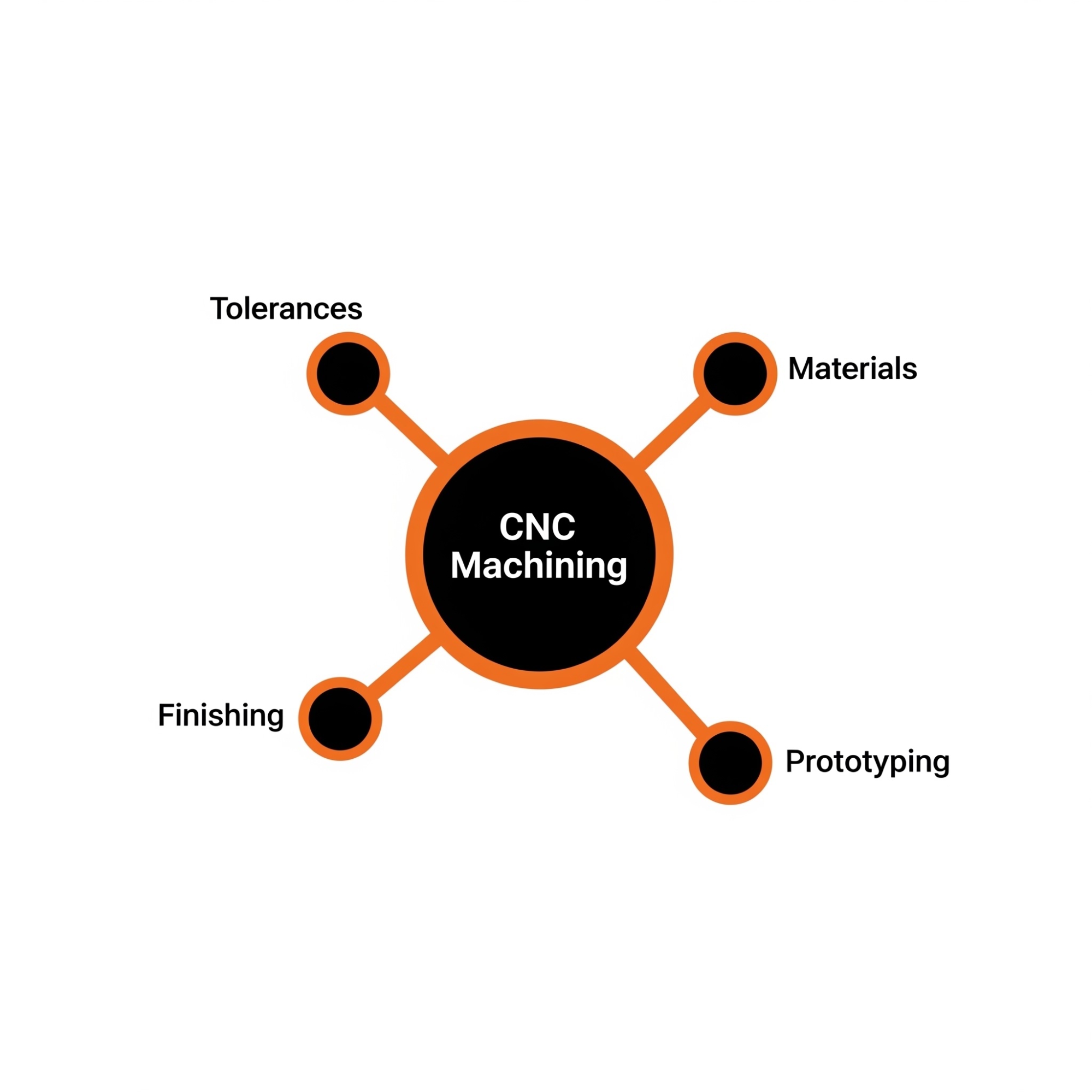
This library could include detailed guides on:
| Topic | Description |
|---|---|
| CNC machining for stainless steel parts | In-depth challenges of tool wear and cooling techniques. |
| Aluminium CNC machining | Maximising structural integrity and speed for lightweight components. |
| Understanding CNC tolerances | A clear breakdown of standard versus precision tolerances for industrial assemblies. |
| Prototyping versus production runs | How setup times and tooling costs shift when scaling from 10 units to 10,000 units. |
| Industrial surface finishes | Comparing anodising, powder coating, and bead blasting for component longevity. |
| Reducing machining costs | Practical design tips for engineers to simplify part geometry and cut production times. |
| Preparing CAD files for CNC production | A checklist for submitting production-ready files to accelerate the quoting process. |
| Quality control in precision machining | Explaining how CMM machines and optical comparators verify strict quality parameters. |
| Choosing a CNC supplier | A guide for procurement officers evaluating technical risk and quality management systems. |
| Export and delivery capabilities | Documenting logistics, customs handling, and transit timelines across European borders. |
When a website hosts an organized, deeply detailed ecosystem of pages like this, search engines recognize the company as a credible authority on the subject.
More importantly, when an international buyer lands on the site, they instantly see proof that the manufacturer possesses the exact technical depth required to handle their project.
2. You’re Publishing Too Infrequently to Build Meaningful Online Visibility
Building a successful business blog requires structural momentum.
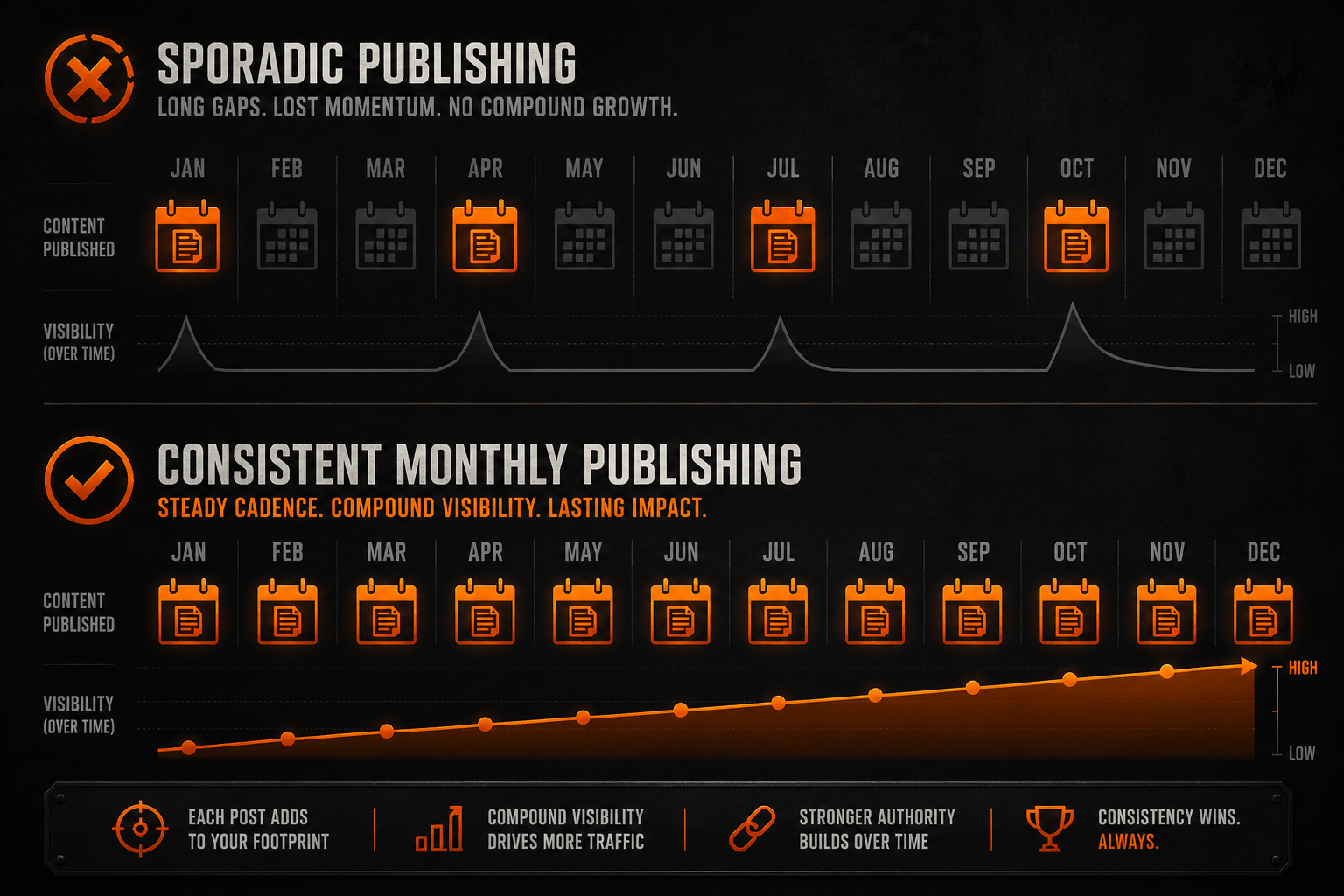
A common mistake is assigning an engineer or sales manager to write one or two articles, publishing them, and then letting the blog sit dormant for six months when daily operational demands take over.
Publishing one or two articles and then stopping usually does not create enough visibility to move the needle.
At the same time, manufacturers do not need to fall into the trap of high-volume marketing agencies that demand 20 to 30 generic articles every month.
Churning out low-quality text for the sake of volume will only waste internal resources and dilute your brand’s reputation.
For industrial companies, consistency and commercial relevance matter far more than extreme volume.
To build a sustainable, manageable content schedule that delivers business results, consider the following practical framework:
- Establish a targeted content plan: Map out topics three to six months in advance, focusing exclusively on your most profitable or underutilised manufacturing capabilities.
- Leverage internal technical experts: Your engineers and shop-floor managers hold the technical insights buyers care about. Instead of asking them to write long articles, have a writer interview them for 20 minutes to extract original technical perspectives.
- Maintain a predictable cadence: Commit to a realistic schedule—such as one highly detailed, thorough article every two weeks—and stick to it reliably.
- Prioritise technical accuracy over marketing flair: In the industrial sector, clear specifications, clear structural outlines, and factual accuracy will always outperform flashy marketing copy.
By treating content production as an ongoing business process rather than a one-time marketing project, you steadily build a digital asset that drives qualified inquiries to your sales team month after month.
3. You’re Producing Generic Content That Could Belong to Any Company
When a manufacturer decides to invest in content, they often outsource the writing to generic copywriters who lack industrial experience. The result is superficial, textbook-style text that fails to display real authority.
Technical buyers, procurement teams, and design engineers spot generic content instantly. If an article reads like a basic encyclopaedia entry, a sophisticated buyer will assume your company lacks expertise.
If you want to convert visitors into active leads, your content must provide concrete evidence that your company understands the practical, day-to-day realities of industrial manufacturing.
Useful manufacturing content should actively feature:
- Detailed technical drawings and component cross-sections
- Clear material specification tables and chemical composition details
- Realistic tolerance limits and machining capability ranges
- Original production-floor photos and machinery snapshots
- Step-by-step engineering explanations of complex production challenges
- Clear documentation of quality-control processes and ISO certifications
- Direct commentary or troubleshooting advice from senior engineers
To ensure every article meets these standards, you can use our framework designed specifically for creating authoritative content—the QRIES approach:
- Q — Quotes or direct input from your internal engineers or technical experts.
- R — Research or references to recognized international manufacturing standards (such as ISO, DIN, or ASTM).
- I — Images, such as technical diagrams, blueprints, or high-resolution photos of finished components.
- E — Examples from real manufacturing situations, detailing how an engineering challenge was resolved on the production floor.
- S — Statistics from the industry, tolerance tables, or measurable technical data.
Consider a practical example: Imagine a sheet-metal fabrication company explaining laser-cutting tolerances for high-strength steel.
Instead of simply stating, “We offer high-precision laser cutting,” a high-quality article would include a detailed tolerance table categorized by material thickness, a close-up photograph of a cleanly cut edge showing minimal dross, a brief explanation from the shop foreman on how assist gases affect edge quality, and a clear list of the specific machinery brands and laser wattages available in the facility.
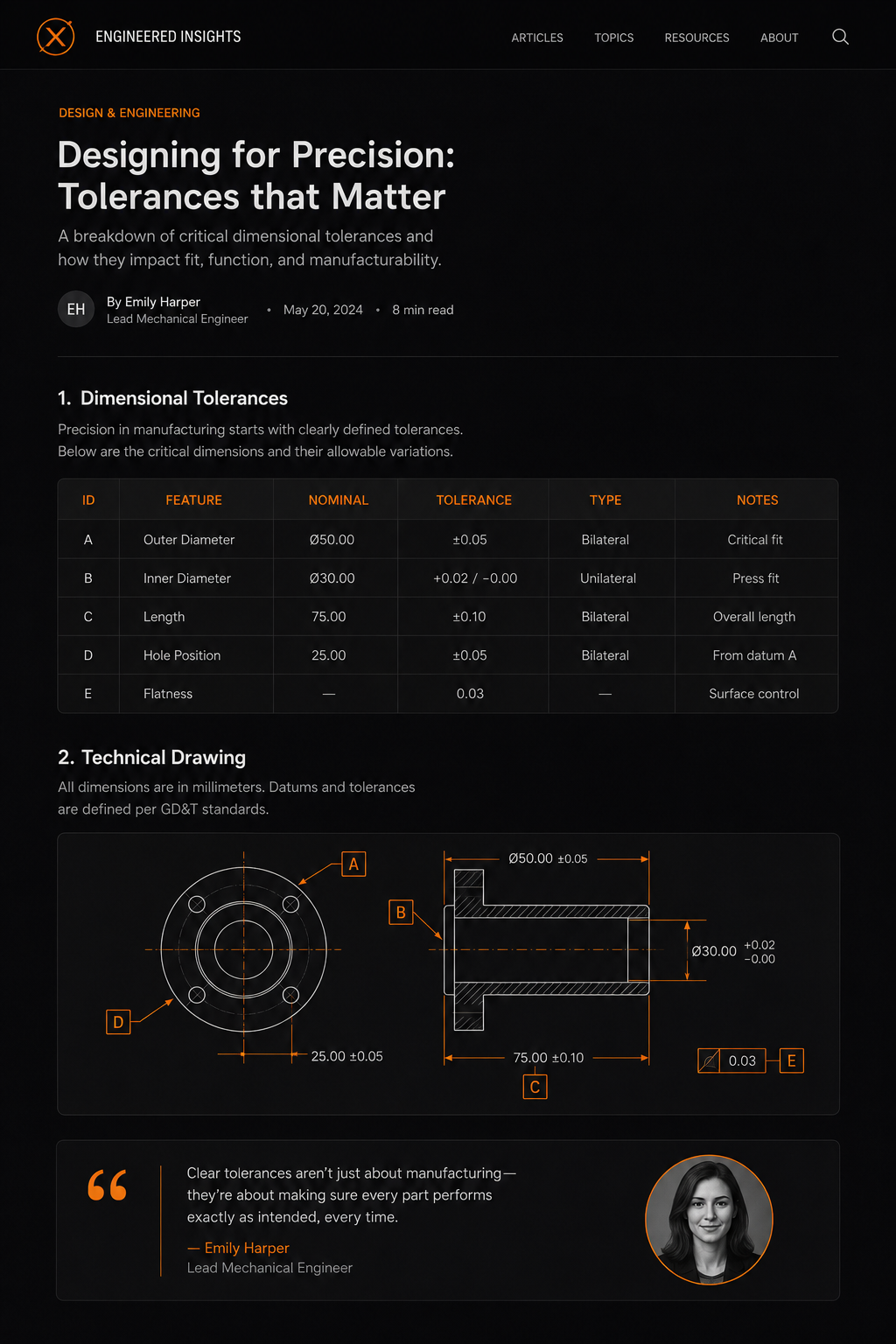
This level of detail gives procurement teams and technical buyers the exact evidence they need to evaluate whether your facility is truly capable of handling their production requirements.
4. You’re Failing to Connect Content With Your Products and Services
The ultimate goal of corporate websites’ blogs is not to share news about your company milestones or attract casual readers; it is to generate qualified business inquiries and RFQs.
A major error many industrial companies make is writing highly educational articles that fail to guide the reader toward the next business step.
While an article should always educate the reader first without immediately turning into an aggressive, low-value sales pitch, it should eventually make your company’s related capabilities visible.
Suppose you publish a highly detailed article about choosing the correct grade of industrial polymer for components exposed to high friction and extreme temperatures.
The article might thoroughly educate the reader on the performance differences between PTFE, PEEK, and heavy-duty nylon.
However, if it ends abruptly without any call to action, or connecting that information to your company’s specific commercial offerings, the reader will take that valuable information and leave to find a supplier elsewhere.
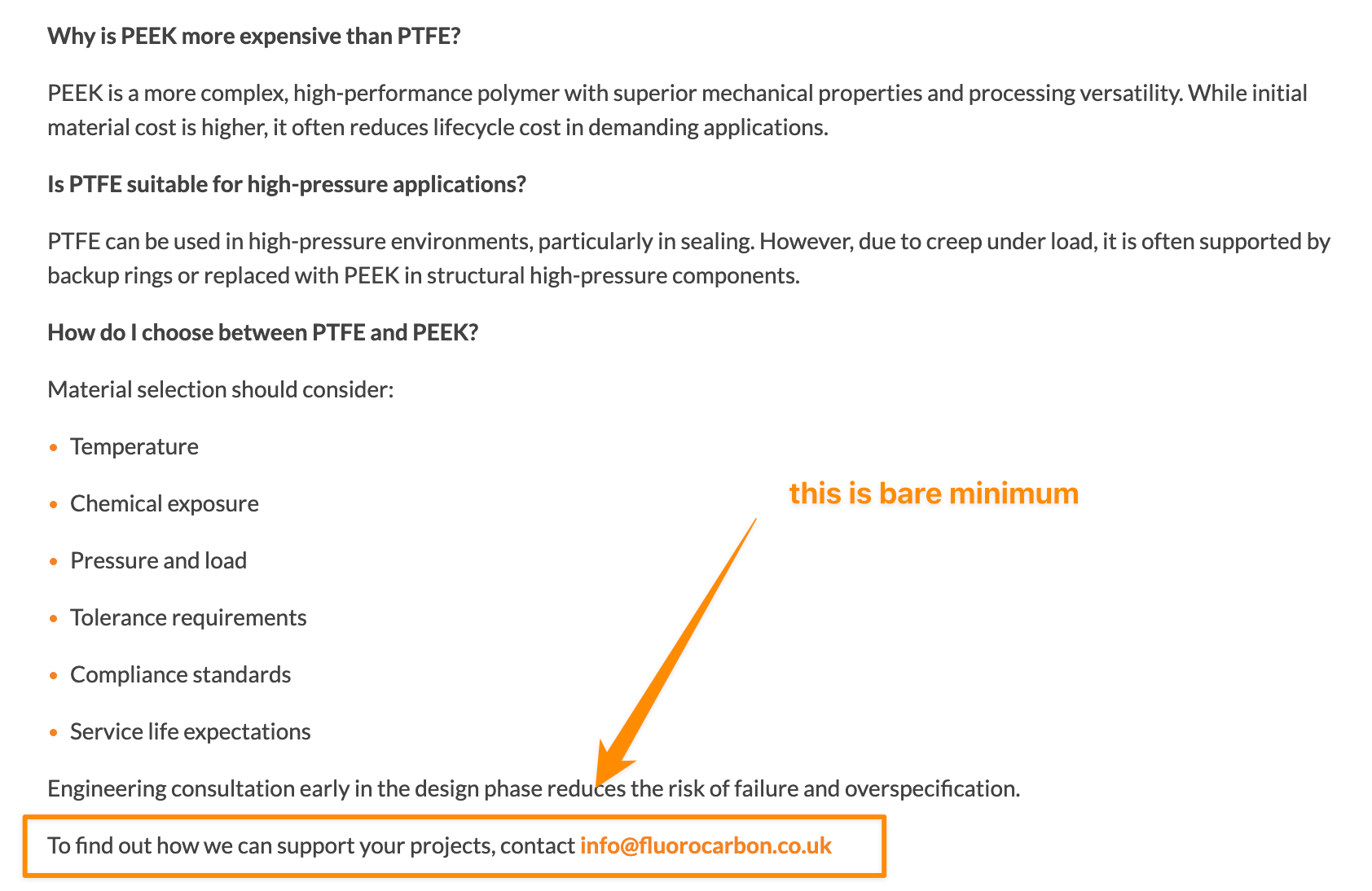
A well-optimised blog should seamlessly introduce relevant commercial context by detailing:
- The exact material grades and dimensions you offer.
- The precise machining or moulding tolerances your equipment can reliably achieve.
- The minimum and maximum production volumes your facility supports.
- The specific industry certifications your processes hold.
- Clear, low-friction paths for the reader to request a technical consultation or a formal quote.
Every educational article should act as a natural bridge to a commercial conversation.
Make sure you provide clear, professional next steps for a buyer who may be facing the exact challenge you just described.
Depending on your business model, these next steps might include inviting the reader to explore a specialized capability page, download a comprehensive technical material guide, submit a CAD drawing for a manufacturing feasibility review, or contact an export manager directly to discuss production capacity.
Conclusion
Publishing articles on a company blog will not automatically generate corporate growth.
A blog functions as a reliable sales and marketing tool only when the company covers the right technical subjects in depth, publishes with consistent regularity, demonstrates undeniable real-world expertise, and directly connects technical content to practical manufacturing services.
By eliminating generic copy and focusing heavily on the detailed, accurate information that procurement teams and engineers actually look for, manufacturers can transform their websites into long-term sources of international inquiries.